

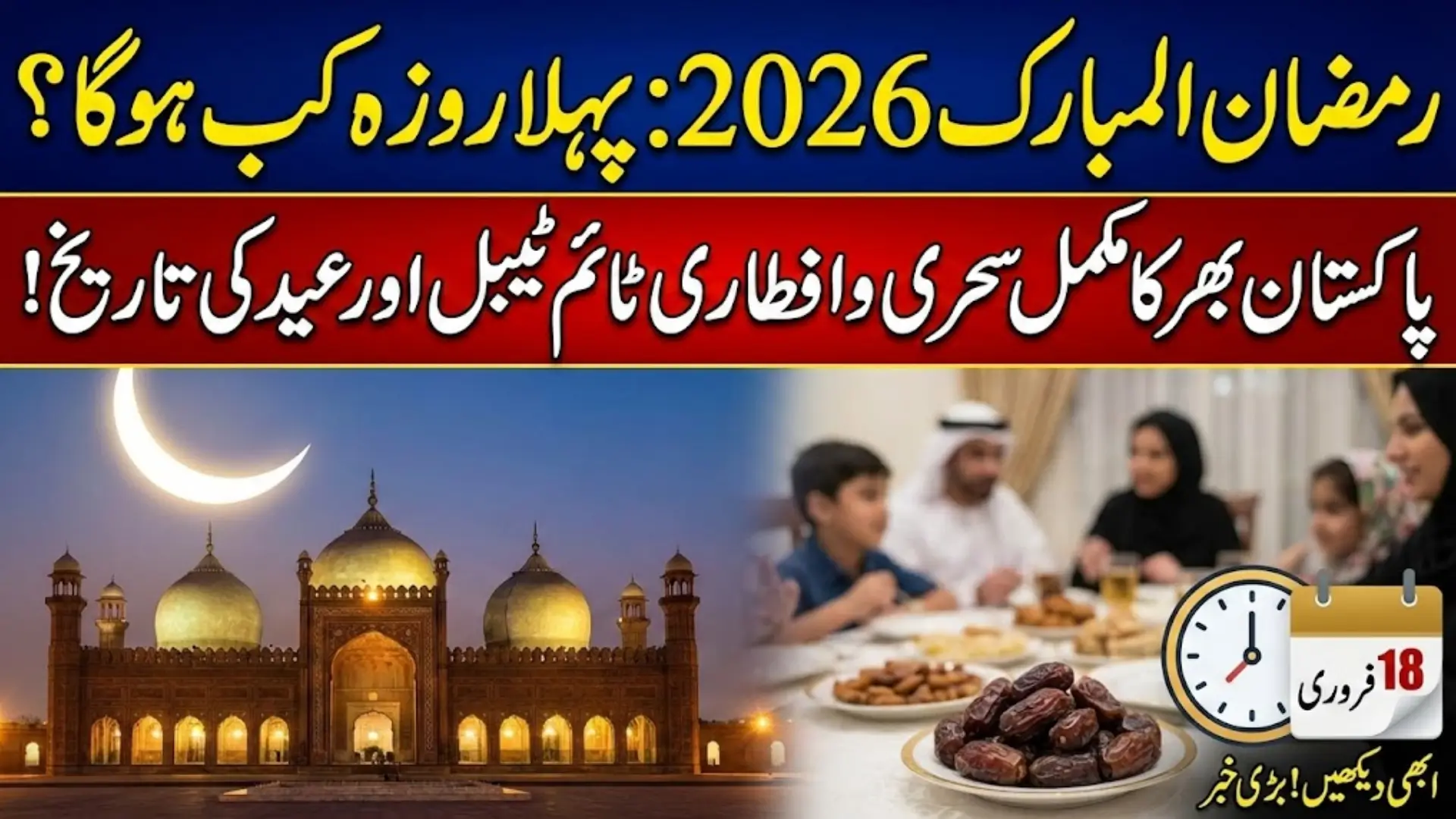
Ramadan Mubarak 2026 Calendar
Ramadan Mubarak 2026 Calendar is approaching, and across Pakistan families have already started searching for the Ramadan 2026 calendar, Sehri timing, Iftar timing, and expected Eid date. Every year, I notice the same scene in our streets and homes. Shopkeepers begin stocking dates and Rooh Afza, mosques update their prayer timetables, and families discuss how many hours the fast will be this year. Ramadan is not just a month; it is a complete spiritual season that changes the routine of the entire country.
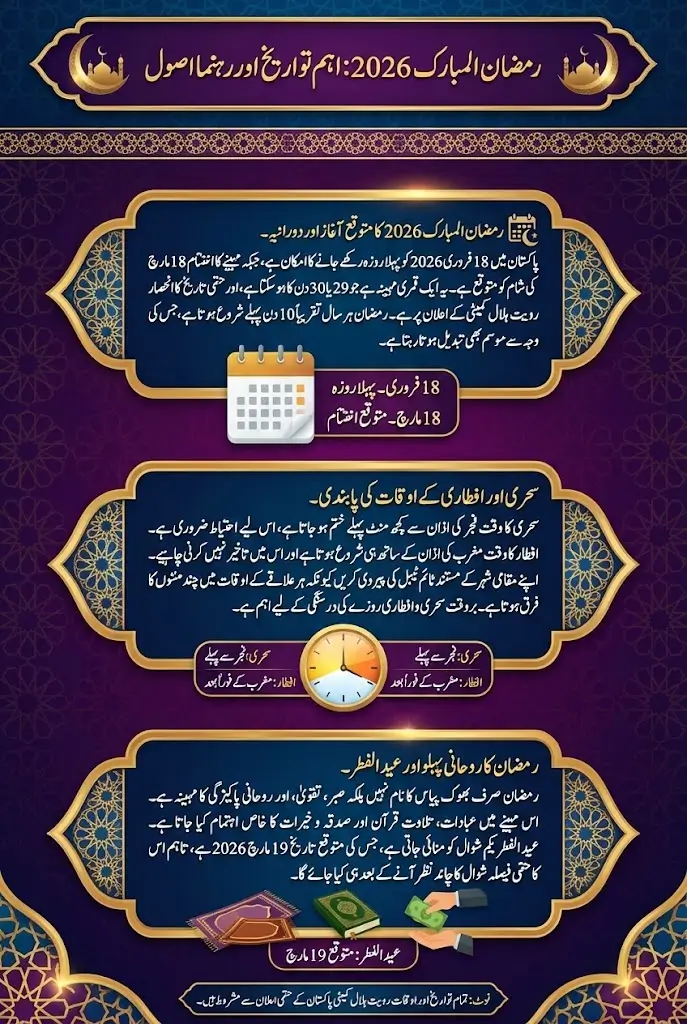
According to available calendar calculations, Ramadan 2026 is expected to begin on the evening of Tuesday, 17 February 2026. The first fast is likely to be observed on Wednesday, 18 February 2026. The holy month is expected to end on the evening of Wednesday, 18 March 2026. However, in Pakistan, the final confirmation always depends on moon sighting. Therefore, while these dates are expected, the official announcement may shift by one day.
Ramadan follows the Islamic lunar calendar, which is around 10 to 11 days shorter than the Gregorian calendar. That is why Ramadan moves earlier every year. In recent years we have seen Ramadan in peak summer, and now it is gradually moving toward milder weather. This change also affects fasting hours.
You Can Also Read: Punjab School Timings During Ramadan 2026
Expected Ramadan 2026 Start and End Dates in Pakistan
For Pakistani readers, the most important question is simple: when will the first fast begin? Based on projections, the month is expected to follow this pattern:
| Event | Expected Date | Day |
|---|---|---|
| Start of Ramadan (Evening) | 17 February 2026 | Tuesday |
| First Fast | 18 February 2026 | Wednesday |
| Expected End of Ramadan | 18 March 2026 | Wednesday |
| Expected Eid al-Fitr | 19 March 2026 | Thursday |
These dates are based on lunar calculations. The official moon sighting committee in Pakistan will confirm the final decision. It is always advised to follow trusted announcements rather than social media rumors.
Important points to remember:
- Ramadan begins after the sighting of the Ramadan moon.
- If the moon is not sighted, Shaban completes 30 days.
- Eid is confirmed after the Shawwal moon is sighted.
- Local announcements may differ slightly from global calendars.
You Can Also Read: Nighaban Program How to Verify Your Eligibility
Ramadan 2026 Prayer Timetable and Daily Fasting Hours
The Ramadan 2026 prayer timetable mentioned in global calendars is calculated according to the Muslim World League method. These timings show the start time of each prayer, not the Jamaat time in the mosque. In Pakistan, mosque Jamaat timing may differ by 10 to 20 minutes.
For example, during the first days of Ramadan 2026, Fajr is expected to begin shortly after 5:00 AM and Maghrib around 5:20 PM in some regions, though exact times will vary by city. As the days pass:
- Fajr time gradually becomes earlier.
- Maghrib time becomes slightly later.
- Total fasting hours slowly increase.
- Isha and Taraweeh timing may adjust accordingly.
If you live in Karachi, Lahore, Islamabad, Peshawar, or Quetta, your city timing will differ slightly. Therefore, always check your local Ramadan 2026 calendar.
From my experience, many families print the timetable and place it on the fridge or near the dining table so no one misses Sehri or Iftar. This small preparation makes a big difference.
Sehri and Iftar Timing Guide for Ramadan 2026
Understanding Sehri and Iftar timing is essential for a valid fast. Sehri ends exactly when Fajr begins. Even a minute matters. Once the Fajr time starts, eating and drinking must stop immediately.
Maghrib marks Iftar time. As soon as Maghrib begins, the fast can be opened. In many Pakistani homes, families sit together with dates and water, waiting for the Adhan.
Key guidelines for Sehri and Iftar:
- Finish eating 1–2 minutes before Fajr for safety.
- Do not delay Iftar after Maghrib.
- Always confirm daily timing.
- Avoid relying only on memory from previous days.
- Keep a printed or mobile Ramadan timetable.
Many people also follow mosque loudspeaker announcements, but having your own timetable provides extra assurance.
You Can Also Read: Punjab Launches Historic Rs 40 Billion Nighaban
The Spiritual Meaning of Fasting in Ramadan
Ramadan is the ninth month of the Islamic calendar and fasting is the fourth pillar of Islam. Fasting is not only about hunger. It is about discipline, patience, and spiritual purification. When I speak to elders in my area, they always say Ramadan trains a person to control desires and improve character.
During Ramadan, Muslims abstain from:
- Food and drink from dawn to sunset.
- Smoking and harmful habits.
- Anger, gossip, and bad language.
- Immoral behavior.
At the same time, they increase:
- Daily prayers and voluntary prayers.
- Recitation of the Holy Quran.
- Charity and support for the needy.
- Forgiveness and reconciliation with others.
This balanced approach makes Ramadan a complete system of personal reform.
You Can Also Read: Apni Zameen Apna Ghar Program Officially Registration Start
Laylatul Qadr and the Last Ten Nights of Ramadan 2026
The last ten nights of Ramadan are spiritually powerful. Among them comes Laylatul Qadr, also known as the Night of Power. It is described as better than a thousand months. Many Pakistani mosques remain open all night during these days.
People especially focus on the odd nights:
- 21st Ramadan
- 23rd Ramadan
- 25th Ramadan
- 27th Ramadan
- 29th Ramadan
In Pakistan, 27th Ramadan is commonly observed with special gatherings and increased worship. On these nights, Muslims offer extra prayers, make dua, and ask for forgiveness. It is a time of deep reflection and hope.
You Can Also Read: Punjab Free Livestock Scheme Phase 2 Launched by Maryam Nawaz Sharif
Why Ramadan Moves Earlier Every Year
Many people ask why Ramadan does not stay in one season. The answer lies in the Islamic lunar calendar. The lunar year is shorter than the solar year by about 10 to 11 days. Because of this:
- Ramadan shifts earlier every year.
- Fasting hours change gradually.
- Weather conditions differ over time.
- School and work schedules adjust accordingly.
This rotation allows Muslims to experience fasting in different seasons throughout their lifetime.
Eid al-Fitr 2026 Expected Date in Pakistan
Eid al-Fitr marks the end of Ramadan. It begins on the first day of Shawwal. Based on current projections, Eid al-Fitr 2026 is expected around 19 March 2026, depending on moon sighting.
Before Eid prayer, Muslims must give Zakat al-Fitr so that even the poor can celebrate. On Eid morning in Pakistan, you will see crowded mosques and open grounds filled with worshippers offering Eid prayer. Families then visit relatives, share meals, and celebrate together.
Important reminders before Eid:
- Pay Zakat al-Fitr before Eid prayer.
- Confirm moon sighting announcement.
- Follow official local timing.
- Avoid spreading unverified news.
Ramadan Mubarak 2026 is not just about checking a calendar. It is about preparing the heart, adjusting daily routines, and reconnecting with faith. By keeping an updated Ramadan 2026 calendar at home and understanding the correct start and end dates, Pakistani families can observe fasting with confidence and peace of mind. May this Ramadan bring mercy, unity, and spiritual growth to every home.
You Can Also Read: PSER 8070 Registration Online 2026 for Ramzan Relief Package Complete Guide