


PTA Spectrum Auction Update Technology
PTA Spectrum Auction Update Technology Pakistan’s telecom sector is entering a new phase as the federal government announces that the upcoming spectrum auction for next-generation mobile services will be completely technology-neutral. This decision reflects a clear intention to future-proof the country’s mobile networks and bring national policy closer to international telecom best practices. Rather than limiting operators to a single technology or generation, the government has opened the door for long-term innovation and flexible network planning.
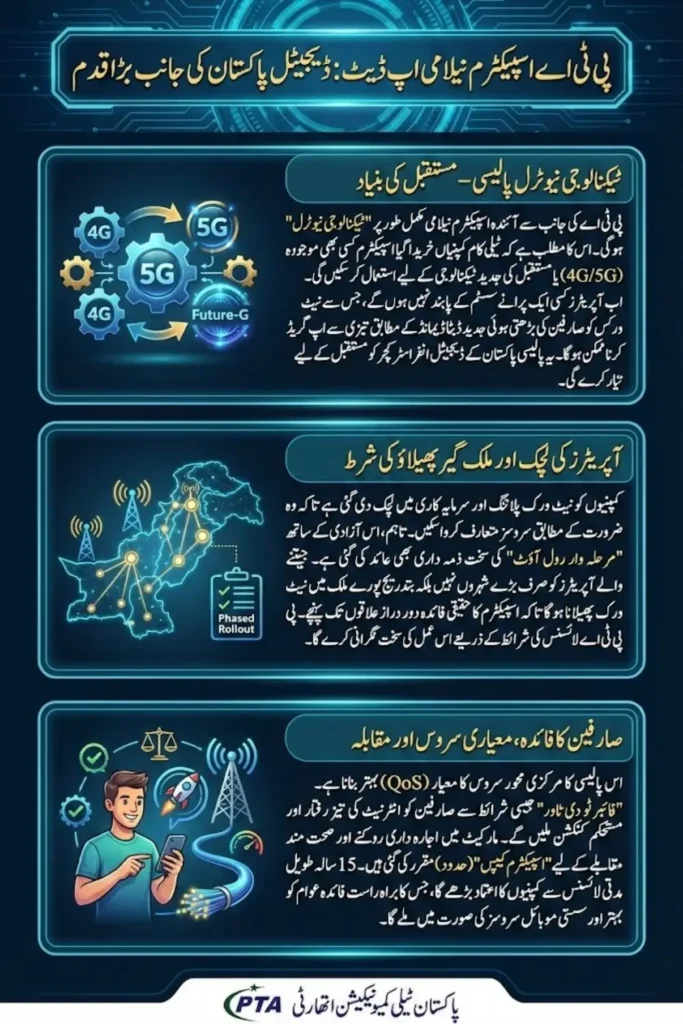
From what I have observed over the years, such policy clarity is critical in Pakistan, where telecom companies invest billions of rupees in infrastructure. A technology-neutral framework removes uncertainty and allows operators to plan networks not just for today’s needs but also for the demands of the coming decade. For users, this signals better services, improved coverage, and faster adoption of modern mobile technologies.
You Can Also Read: 9th Class Date Sheet 2026 Punjab Boards
What Technology-Neutral Spectrum Really Means
Technology neutrality simply means that the spectrum sold in the auction can be used for any existing or future mobile technology, as long as it complies with government policy. This includes current IMT standards and any advanced technologies that may emerge in the future. Operators are no longer locked into a specific system or generation when they purchase spectrum.
This approach is especially important in a fast-changing digital environment. Consumer behavior in Pakistan has shifted rapidly toward data-heavy usage, video streaming, online education, and digital payments. By allowing operators to choose technologies freely, the policy ensures that networks can evolve naturally with user demand instead of being held back by outdated licensing conditions.
You Can Also Read: Winter Vacation In Punjab 2026 Notification Extension for Schools
Why Flexibility Matters for Telecom Operators
For telecom companies, flexibility is not a luxury; it is a necessity. Network planning involves long-term investments in towers, fiber, and core systems. With technology-neutral spectrum, operators can adjust their rollout strategies as technology improves and costs change.
In practical terms, this means operators can:
- Upgrade networks without waiting for new regulatory approvals
- Introduce advanced services where demand is highest
- Optimize investment based on commercial and consumer realities
This flexibility ultimately benefits users, because operators can focus on improving service quality instead of navigating regulatory limitations.
You Can Also Read: BISP 8171 Payment Update: Head Office Verifying Beneficiary
Coverage of Present and Future Mobile Technologies
The policy clearly states that the auctioned spectrum can support all generations of mobile technologies, including future innovations beyond current IMT standards. This is a strong signal that the government is thinking long-term rather than focusing on short-term gains.
Such clarity reduces the risk of spectrum becoming obsolete. In a country like Pakistan, where rural connectivity is still a challenge, long-lasting and adaptable spectrum use is essential for sustainable digital growth.
Phased Network Rollout Obligations Explained
While the policy gives operators freedom in technology choice, it also places responsibility on them through phased rollout obligations. Winning bidders will be required to expand their networks gradually but consistently, instead of delaying deployment after acquiring spectrum.
These obligations ensure that spectrum is actually used to improve connectivity rather than being held for speculative purposes. The phased approach allows operators to balance financial planning with national coverage goals, making the process realistic and enforceable.
You Can Also Read: BISP 13500 Payment January 2026
PTA’s Enforcement Role and License Conditions
The Pakistan Telecommunication Authority has been tasked with embedding clear rollout benchmarks into the licenses. These benchmarks will focus on measurable factors such as the number of cities covered, network site deployment, and infrastructure readiness.
From a regulatory standpoint, this strengthens PTA’s ability to monitor performance. It also gives the public confidence that operators will be held accountable if they fail to meet their commitments.
Focus on Quality of Service and Fiber Deployment
Improving Quality of Service is a central pillar of the new policy. Requirements such as fiber-to-the-tower deployment are meant to address common user complaints like slow internet speeds and network congestion.
For everyday users, especially in smaller cities, this could mean:
- More stable mobile internet connections
- Faster data speeds during peak hours
- Better performance for online work and education
These improvements are critical as Pakistan’s economy becomes more digitally dependent.
You Can Also Read: Imam Masjid Wazifa Apply Online 2026
Spectrum Caps to Protect Competition
To maintain a fair and competitive market, the policy introduces spectrum caps that limit how much spectrum a single operator can hold. This prevents market dominance and encourages healthy competition among telecom companies.
The policy includes:
- An overall cap of 40 percent of total available spectrum
- Separate limits for low-band, mid-band, and high-band spectrum
- Safeguards to ensure smaller operators can compete
Such measures are important in preventing monopolistic behavior and keeping services affordable for consumers.
License Duration and Investment Confidence
Licenses issued through the auction will be valid for 15 years, offering long-term certainty to investors. This duration aligns well with the financial realities of telecom infrastructure development, which requires time to deliver returns.
Longer licenses encourage operators to invest in better equipment, wider coverage, and more reliable networks, all of which directly benefit end users.
You Can Also Read: Can One House Have Multiple Electricity
Spectrum Trading and Sharing Provisions
The inclusion of spectrum trading and sharing provisions is another progressive step. These mechanisms allow operators to manage spectrum more efficiently and collaborate where necessary to expand coverage.
In practical terms, this can help reduce infrastructure duplication and speed up network expansion, especially in underserved regions.
Key Features of the Technology-Neutral Spectrum Policy
| Policy Area | Key Details |
|---|---|
| Spectrum Usage | All existing and future mobile technologies |
| License Validity | 15 years |
| Rollout Model | Phased, nationwide expansion |
| Quality Standards | Enhanced QoS and fiber-to-tower deployment |
| Competition Rules | Overall and band-specific spectrum caps |
What This Means for Pakistan’s Digital Future
This technology-neutral spectrum auction represents a balanced approach that combines flexibility with responsibility. Operators gain the freedom to innovate, while regulators ensure that national coverage and service quality goals are met.
For the ordinary Pakistani user, this policy holds the promise of better connectivity, stronger mobile broadband, and a more competitive telecom market. If implemented effectively, it could play a major role in shaping Pakistan’s digital future and improving access to modern communication services across the country.
You Can Also Read: 8171 Check Online CNIC Ehsaas Program