

Multiple Electricity Meters
Multiple Electricity Meters? WAPDA Rules 2026 Electricity has become one of the biggest monthly expenses for Pakistani households in 2026. With rising tariffs, shrinking subsidy slabs, and frequent billing disputes, families are looking for legal ways to manage their electricity costs. In joint family homes, where two or three families live under one roof, the pressure is even higher.
Over the past year, I have personally seen people arguing at DISCO offices, landlords fighting with tenants, and homeowners panicking because of viral WhatsApp messages claiming that WAPDA has banned multiple electricity meters in one house. These claims sound alarming, but they are largely misleading.
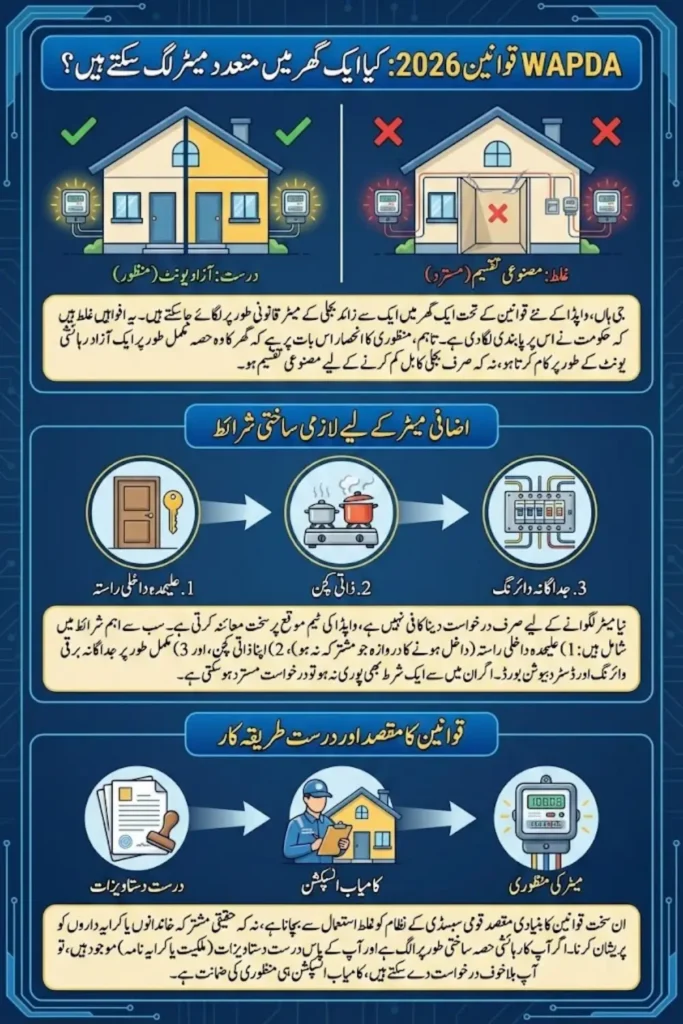
The reality under WAPDA Rules 2026 is more balanced and practical. Multiple electricity meters are still allowed in one house, but only when the house is genuinely divided into independent residential units. This article explains the rules as they exist today, without rumors, political noise, or technical jargon.
You Can Also Read: 8171 Check Online CNIC Ehsaas Program
Understanding WAPDA Rules 2026 – What Has Actually Changed?
In 2026, the Power Division of Pakistan, in coordination with WAPDA and NEPRA, issued clear instructions to electricity distribution companies (DISCOs) to tighten monitoring of new connections. This move was misunderstood by the public as a complete ban on additional meters.
From discussions with field officers and homeowners, it is clear that the government’s intention was never to punish joint families or tenants. The real target was misuse of subsidized electricity slabs, where a single household was splitting loads artificially to pay less.
Under the updated framework, the rule is simple and logical: each electricity meter must serve one independent household unit. If a portion of a house operates like a complete home, it qualifies. If it does not, approval can be denied.
This clarification has been especially important for:
- Joint families living on separate floors
- Homeowners renting out independent portions
- Tenants demanding transparent billing
You Can Also Read: Parwaz Card Gov PK Online Registration Portal
Are Multiple Electricity Meters Allowed in One House in 2026?
Yes, multiple electricity meters are legally allowed under WAPDA Rules 2026. However, approval is not based on how many families live together or how expensive electricity has become. Approval depends entirely on physical and functional separation.
I have seen large houses with three legal meters and small houses rejected for a second meter. The difference was not influence or location, but compliance with structural rules.
WAPDA does not recognize emotional or family arguments. It recognizes household units.
Key clarification points:
- One meter per independent unit
- Not one meter per brother, son, or tenant
- Shared facilities often lead to rejection
- Inspection matters more than paperwork
You Can Also Read: Double Decker Bus Karachi Route Started
Mandatory Conditions for Installing an Additional Electricity Meter
This is the most important part of the entire process, and also where most applications fail. Many people assume that an affidavit alone is enough, but that is no longer true in 2026.
For WAPDA, an independent unit must look and function like a complete house. Inspecting officers are trained to identify artificial partitions and shared systems.
Structural Conditions (Non-Negotiable)
- Separate entrance that does not rely on another portion
- Dedicated kitchen used only by that portion
- Independent electrical wiring and distribution board
- Clearly defined living and sleeping areas
Legal and Administrative Requirements
- CNIC of the applicant
- Ownership documents or registered rent agreement
- Affidavit confirming separate household status
- Successful on-site inspection by DISCO officials
If even one major condition is missing, approval can be delayed or rejected without much explanation.
You Can Also Read: 8070 Web Portal For Register In Ramzan Rashan
Can Tenants Apply for a Separate Electricity Meter Under WAPDA Rules 2026?
Yes, tenants are fully eligible to apply for a separate electricity meter, and this has been officially confirmed under WAPDA Rules 2026. This policy has reduced many disputes that previously existed between landlords and tenants over shared bills.
However, tenant applications are scrutinized more carefully. DISCOs want clear proof that the tenant’s portion is independent and that the landlord has no objection.
To qualify, tenants must provide:
- Written permission from the landlord
- Valid and signed rent agreement
- Separate entrance and kitchen
- Independent electrical wiring
Without landlord consent, applications are usually rejected, regardless of how complete the portion is.
Key Requirements for Additional Electricity Meter Approval
| Requirement Category | What WAPDA Checks During Inspection |
|---|---|
| Household Status | Independent residential use |
| Kitchen | Separate and functional |
| Entrance | Not shared with another portion |
| Electrical Wiring | Completely independent |
| Legal Authority | Owner documents or rent agreement |
| Affidavit | Declaration of separate household |
This table reflects what actually matters on the ground during inspections.
You Can Also Read: Understanding PMT Score in BISP Calculation
Step-by-Step Process to Apply for an Additional Meter
Applying for an additional electricity meter is not complicated, but it requires preparation. Many people face delays simply because they apply before ensuring compliance.
The standard process followed by most DISCOs includes:
- Visiting your local DISCO office (LESCO, IESCO, FESCO, MEPCO, K-Electric, etc.)
- Obtaining the new connection or additional meter form
- Submitting all required documents
- Allowing physical site inspection
- Paying security deposit and connection charges
- Waiting for meter installation after approval
In most cities, the entire process takes two to four weeks, depending on workload and inspection schedules.
You Can Also Read: 5566 Rashan Program Online Check By 8123
Why the Government Tightened Monitoring in 2026
The stricter approach introduced in 2026 is mainly about protecting the national subsidy system. Electricity subsidies are meant for low-usage households, not for artificially divided homes.
Authorities are now actively checking:
- Multiple meters under one CNIC
- Fake household separations
- Shared wiring hidden during inspections
- False affidavits
For genuine users, these changes are not a threat. They are actually a form of protection against unfair practices.
You Can Also Read: Akf Punjab Gov Pk Login For Asaan Karobar Card
Common Reasons Applications Get Rejected
From cases I have personally observed, most rejections happen for predictable reasons. Knowing them beforehand can save time and money.
Common rejection causes include:
- No separate kitchen
- Shared electrical wiring
- Temporary or fake partitions
- Incorrect or misleading affidavits
- Landlord objection in tenant cases
Most of these issues can be fixed before applying.
You Can Also Read: Ehsaas Rashan Program Registration Online
FAQs
Can I have two electricity meters under one CNIC?
Yes, if both meters serve separate residential units and pass inspection.
Is a separate kitchen mandatory?
Yes. Without a kitchen, approval is extremely unlikely.
Are old additional meters still legal in 2026?
Yes, if they were installed legally, they remain valid.
Can WAPDA remove an existing meter?
Only if subsidy misuse or rule violations are proven.
Final Verdict
Under WAPDA Rules 2026, installing more than one electricity meter in a single house is completely legal, provided each portion is a genuine, independent household. These rules reflect Pakistan’s joint family culture while ensuring fairness in electricity distribution.
From what I have seen, the biggest problem is not the law, but misinformation. If your portion is structurally separate, properly wired, and legally documented, you have nothing to fear. Understanding the rules before applying makes all the difference.