


Examination Fees Massively Increase
Examination Fees Massively Increase new academic cycle of 2026 has brought unsettling news for students appearing in Punjab board examinations. All major education boards across the province have significantly increased examination fees, creating panic among students and parents alike. At a time when inflation is already squeezing household budgets, this sudden rise has added another layer of stress, especially for families with more than one child preparing for FA or FSc exams.
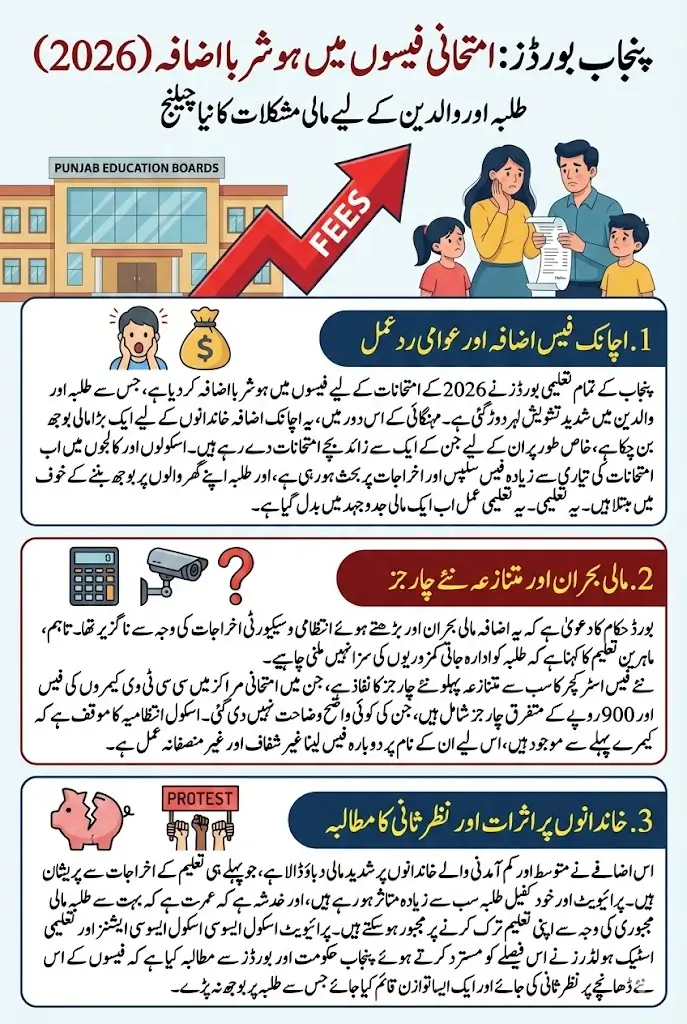
From what I have personally observed in schools and colleges, discussions about exams are no longer limited to preparation and dates. Instead, fee slips have become the main topic of concern. Parents visiting colleges are shocked by the final amount, while students fear becoming a burden on their families. This fee hike has turned what should be a routine academic process into a financial struggle.
You Can Also Read: Silver Rate In Pakistan Today 2026
Financial Crisis Behind the Boards’ Decision
Officials from Punjab education boards claim that the fee increase is the result of a serious financial shortfall. According to them, rising administrative costs, examination arrangements, and security-related expenses have made it difficult to manage operations under the old fee structure. To keep the system running, boards believe increasing fees was the only option left.
However, many education experts argue that students should not be made to pay for institutional weaknesses. In Pakistan, education boards are public bodies, and their financial gaps should ideally be addressed through better planning or government support. The claim that boards expect to collect nearly Rs. 15 billion through revised fees has further fueled public anger.
You Can Also Read: Public Holidays in 2026 Announced
Introduction of New Charges in Board Exams
One of the most debated aspects of the new fee structure is the addition of entirely new charges. Boards have introduced a separate fee for CCTV cameras at examination centers and added a hefty miscellaneous charge without providing clear explanations.
Key newly added charges include:
- CCTV camera installation fee at exam centers
- Rs. 900 miscellaneous charges
- Additional minor administrative costs
School management bodies argue that most examination halls already have CCTV cameras installed. From their perspective, asking students to pay again for facilities that already exist reflects poor transparency and unfair decision-making.
You Can Also Read: Ration Cards Approved for Workers
Sharp Increase in Certificate and Processing Costs
Another major change that has gone largely unnoticed by many until now is the sharp increase in certificate and processing fees. Earlier, students paid Rs. 550 for their certificates, but this amount has now almost doubled to Rs. 1,000. Processing fees have also been raised to the same level, further increasing the total cost.
Individually, these amounts may not seem overwhelming, but when combined with other charges, they significantly inflate the final bill. Families with limited income find it extremely difficult to justify these increases, especially when certificates are a basic right of students who have already passed their exams.
Revised Total Fee for Private and Regular Candidates
After including all revised charges and taxes, the total fee payable by students has reached a level that many consider unreasonable. Private candidates, who usually do not receive institutional support, are the most affected by this decision.
- Private FA and FSc candidates now pay Rs. 7,730
- Regular FA and FSc students now pay Rs. 7,570
Although the numerical difference is small, private candidates often bear additional expenses for tuition and registration, making this increase far more painful for them.
Detailed Fee Breakdown for Intermediate Exams 2026
For intermediate annual examinations starting from May 20, 2026, Punjab boards have released a detailed breakdown showing how the total fee is calculated. This table clearly reflects how multiple small charges combine into a heavy financial burden for students.
| Fee Component | Amount (Rs.) |
|---|---|
| Admission Fee | 1,000 |
| Registration Fee | 1,000 |
| Processing Fee | 1,000 |
| Certificate Fee | 1,000 |
| Miscellaneous Charges | 900 |
| CCTV Charges | 30 |
| Development Charges | 350 |
| Scholarship Fee | 250 |
| Postal Charges | 300 |
This breakdown explains why parents feel the final amount is excessive. Many believe that several of these charges could either be reduced or merged to lessen the burden on students.
You Can Also Read: TANK-500 HEV and PHEV Prices
Category-Wise Admission Fee Differences
Punjab boards have also introduced different admission fees based on subject groups and student categories. Science students are required to pay more than arts students, while private candidates are charged higher than regular students.
According to education observers, this difference has existed for years but has now become more noticeable due to the overall increase. Students question why science subjects cost more when examination centers, invigilators, and basic facilities remain largely the same for all groups.
Strong Reaction from Private School Associations
The revised fee structure has been strongly criticized by private school and college associations across Punjab. Leaders from major education bodies have openly rejected the increase, calling it unjust, ill-timed, and harmful for students.
Their main objections include:
- Students should not pay for CCTV systems already installed
- The Rs. 900 miscellaneous fee lacks transparency
- Certificate and processing fee increases are excessive
These associations believe that if the decision is not reviewed, it could damage trust between education boards and institutions.
You Can Also Read: 8171 PMT Score Check Using Online Portal for BISP Payment
Dispute Over CCTV and Miscellaneous Charges
The CCTV fee has emerged as the most controversial charge in the new structure. School representatives argue that surveillance systems have been mandatory in examination halls for years, and their maintenance should fall under board budgets, not student fees.
Similarly, the miscellaneous fee has been labeled vague and unjustified. Without clear details on how this money will be used, parents and educators fear it may become a permanent and unchecked charge in future examinations as well.
Growing Pressure on Middle- and Low-Income Families
For many Pakistani families, education is already one of the largest monthly expenses. Rising school fees, tuition costs, and now higher examination charges are pushing parents to their limits. Middle- and low-income households are the worst affected, especially in rural areas.
There is growing concern that such financial pressure may force some students to delay or even abandon their intermediate education. Private candidates and self-supporting students are particularly vulnerable, as they lack institutional backing.
You Can Also Read: BISP New Digital Card Online Registration & Payment Guide
Calls for Review and Policy Reconsideration
Education stakeholders are now demanding that the Punjab government and education boards review the revised examination fee structure. Many believe that a balance can be achieved where boards remain financially stable without overburdening students.