


Double Decker Bus Karachi Route Started
Double Decker Bus Karachi Route Karachi has finally seen a transport development that feels practical rather than just another announcement. The launch of the double-decker bus service in the city has drawn attention from daily commuters who struggle every day with overcrowded buses, unsafe travel conditions, and rising fuel costs. For a city where millions depend on public transport, even a small improvement feels significant.
As someone who regularly travels across Karachi, it is easy to see why people are discussing this service. Traffic congestion, broken roads, and long waiting times have become part of daily life. Against this reality, the introduction of double-decker buses gives hope that public transport may slowly improve, even if the challenges are far from over.
You Can Also Read: 8070 Web Portal For Register In Ramzan Rashan Through PSER Survey
Karachi Introduces a New Double Decker Bus Experience
The double-decker bus service is a new experience for many Karachiites, especially the younger generation who have only seen such buses in pictures or foreign cities. These buses are designed to carry more passengers at one time, which can help reduce pressure on already crowded routes.
On the first day, people were visibly curious. Many commuters stopped to ask about routes, fares, and timings. Some boarded the bus just to experience it once. This reaction shows that citizens are eager for better transport options, provided they are affordable and reliable.
You Can Also Read: Understanding PMT Score in BISP Calculation and Eligibility Criteria
Official Launch and Government Announcement
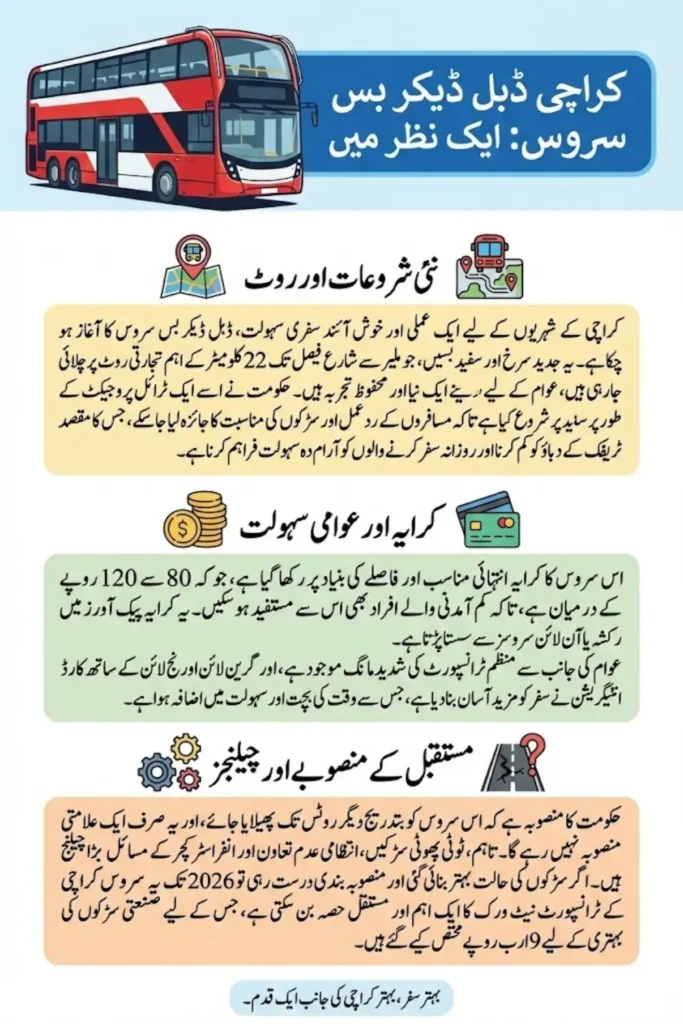
The service was officially launched by Sindh Minister for Transport Sharjeel Inam Memon, who described it as a trial project. According to him, the government wants to monitor passenger response, road suitability, and operational challenges before expanding the service further.
He also shared that discussions have already taken place with Chief Minister Syed Murad Ali Shah regarding future expansion. This suggests that the double-decker bus project is not meant to remain symbolic but could become a permanent part of Karachi’s transport network if managed properly.
You Can Also Read: 5566 Rashan Program Online Check By 8123
Complete Route Coverage and Distance Explained
At present, the double-decker bus operates on a carefully selected route that covers 22 kilometres. This route connects Malir with Shahrah-e-Faisal, two areas that experience heavy daily traffic due to offices, industries, and residential zones.
This corridor was chosen because thousands of people travel on it daily for work, education, and business. By adding a high-capacity bus on this route, the government aims to ease congestion and provide a safer travel option.
Key points of the current route include:
- Starting point from Malir, a densely populated area
- Ending at Shahrah-e-Faisal, Karachi’s main commercial artery
- Coverage of major commuting zones with heavy passenger flow
You Can Also Read: Akf Punjab Gov Pk Login For Asaan Karobar Card
Double Decker Bus Fare Structure for Passengers
One of the most important questions for commuters is affordability. According to the transport minister, fares have been kept within a reasonable range so that even low-income passengers can use the service without difficulty.
The pricing follows a distance-based structure, similar to other public transport systems in Karachi. This makes it easier for passengers to understand and accept the cost.
You Can Also Read: Ehsaas Rashan Program Registration Online
Double Decker Bus Fare Details
| Route Coverage | Fare Amount |
|---|---|
| Short distance travel | Rs 80 |
| Full route (Malir to Shahrah-e-Faisal) | Rs 120 |
For many daily commuters, this fare is cheaper than using rickshaws or ride-hailing services, especially during peak hours.
Daily Commuter Statistics Show Growing Demand
During the inauguration, the transport minister shared statistics that clearly show how much Karachi depends on public transport. According to official figures, around 125,000 people use the People’s Bus Service daily, while 65,000 passengers travel on the Green Line BRT every day.
These numbers reflect a strong public demand for organized transport. If the double-decker bus service proves reliable, it is likely to attract a similar volume of passengers over time.
You Can Also Read: Release of 15 Lakh Loans Under Apni Chhat Apna Ghar
Future Expansion Plans Under Discussion
The Sindh government has acknowledged that one route is not enough for a city as large as Karachi. Officials have stated that more double-decker buses will be introduced gradually, depending on performance and road conditions.
However, expansion will not be simple. Many roads in Karachi are narrow, damaged, or poorly maintained. Until infrastructure improves, route expansion will remain limited.
Green Line and Orange Line Integration Benefits
Another positive development is the integration of the Green Line and Orange Line BRT services. Passengers can now travel on both routes using a single card, which reduces inconvenience and saves time This step shows that authorities are slowly moving toward a connected transport system. Such integration will be essential if double-decker buses are added to more routes in the future.
You Can Also Read: BISP 2025 Registration Criteria Changes
Red Line BRT and Industrial Road Improvements
The transport minister also confirmed that construction work on the Red Line BRT project has resumed after delays. This project is expected to connect key areas and reduce pressure on existing routes once completed.
Additionally, Rs 9 billion has been allocated for road improvements in industrial areas, where heavy vehicles often damage roads. These improvements are crucial for the success of any public transport initiative.
Karachi’s Road Infrastructure Still a Major Challenge
Despite new bus services, Karachi’s road conditions remain a serious concern. Many roads have been broken or dug up for months due to water, sewage, and gas pipeline work. These conditions slow down traffic and damage vehicles.
Residents in districts such as East, West, South, Central, Keamari, Malir, and Korangi continue to suffer from poor infrastructure, rising pollution, and health issues caused by dust and stagnant sewage.
Administrative Issues Affecting Development
One major issue highlighted by experts is Karachi’s divided administrative control. The city is managed by 23 different institutions, while the Karachi Metropolitan Corporation controls only 32% of the land.
This lack of coordination often results in delays and incomplete projects. Even when funds are allocated, implementation remains weak due to overlapping responsibilities.
Public Frustration and Unfulfilled Promises
Residents of areas like North Nazimabad say that their roads were once among the best in Karachi but are now in poor condition. Gas pipeline excavation by SSGC has further damaged roads, and repairs have been slow or incomplete.
Despite announcements of a Rs 25 billion infrastructure package, many citizens feel that real change is still missing on the ground.
Conclusion
Double Decker Bus Karachi Route launch of the double-decker bus service in Karachi is a welcome and positive step. It provides relief to commuters traveling between Malir and Shahrah-e-Faisal and shows that public transport is finally receiving attention.
However, without long-term improvements in road infrastructure, governance, and planning, such initiatives may struggle to reach their full potential. If managed properly, the double-decker bus service can become a meaningful part of Karachi’s transport system by 2026, rather than just another short-term experiment.