

BISP 8171 Payment Update
BISP 8171 Payment Update has introduced a major verification step ahead of the January 2026 installment, focusing specifically on beneficiary SIM verification. From recent observations and field reports, one of the biggest reasons for payment delays in previous cycles was not eligibility, but incorrect or unverified mobile numbers. Many beneficiaries were eligible on paper, yet their payments were stopped simply because the registered SIM was not linked to their own CNIC.
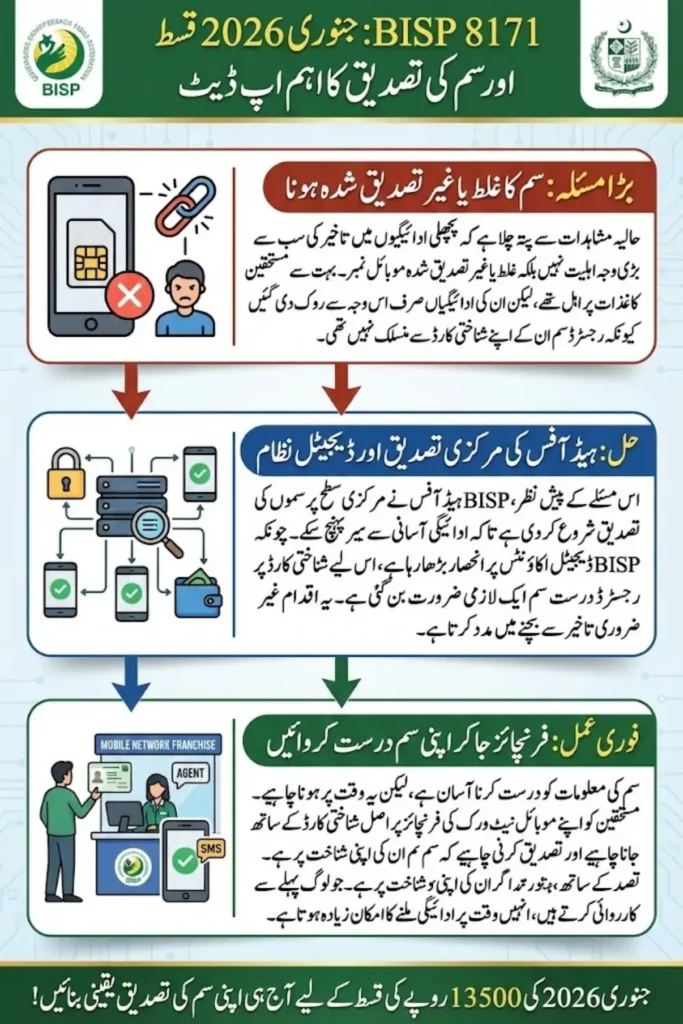
Keeping this issue in mind, the BISP head office has started verifying beneficiary SIMs at the central level to ensure that the Rs 13,500 payment reaches deserving families smoothly. As BISP increasingly relies on digital accounts, SMS alerts, and biometric confirmations, a valid CNIC-registered SIM has become an essential requirement rather than a formality.
You Can Also Read: BISP 13500 Payment January 2026
Why SIM Verification Became Necessary Before January 2026 Payments
During earlier BISP payment phases, a large number of complaints were received from beneficiaries who did not receive SMS notifications from 8171 or faced repeated verification failures at payment points. Upon investigation, it became clear that many mobile numbers were either inactive, registered on another person’s CNIC, or changed without updating BISP records.
To prevent these avoidable problems in January 2026, the head office decided to clean beneficiary data in advance. This step helps ensure that once payments are released, beneficiaries do not face unnecessary delays or repeated visits to Tehsil offices.
Main reasons behind this verification drive include:
- SMS 8171 not reaching the actual beneficiary
- OTP and biometric verification failures
- Delays in digital account fund transfers
- Increased complaints during payment weeks
You Can Also Read: Imam Masjid Wazifa Apply Online 2026
Role of BISP Head Office in Centralized Verification
Unlike previous payment rounds where verification mostly happened at the local level, this time the process is being handled centrally. The BISP head office is cross-checking beneficiary CNIC data with registered SIM information through coordination with telecom operators. This allows issues to be identified early, before payments are released.
This centralized system not only improves accuracy but also reduces pressure on local offices. Beneficiaries whose SIM records are correct will move smoothly into the payment phase, while those with issues will be guided to resolve them in time.
You Can Also Read: Can One House Have Multiple Electricity Meters
Link Between SIM Verification and Digital Account Payments
With the introduction of digital accounts, SIM verification has become directly linked to payment success. Mobile numbers are now used for transaction alerts, confirmation messages, and sometimes for identity verification during withdrawals. If the SIM is not registered on the beneficiary’s CNIC, the system may block or delay the payment.
From recent ground experience, beneficiaries with correct SIM records reported fewer issues at ATMs and banks. On the other hand, those using SIMs registered on relatives’ CNICs often missed alerts or faced verification problems.
Key benefits of a CNIC-registered SIM include:
- Timely SMS alerts from 8171
- Smooth ATM and bank withdrawals
- Reduced chances of payment suspension
- Better protection against fraud
You Can Also Read: 8171 Check Online CNIC Ehsaas Program
Beneficiaries Most Affected by SIM Mismatch Problems
SIM mismatch issues are more common than many people realize. Women beneficiaries in rural areas often use SIMs registered on their husband’s or son’s CNIC. Similarly, families that change mobile numbers frequently but do not update BISP records face higher risks of payment delays.
BISP is now paying special attention to such cases. Beneficiaries in these categories are strongly advised to correct their SIM details before the January 2026 installment to avoid missing the first phase.
How to Check and Correct SIM Information Easily
Correcting SIM information is a simple process, but it must be done on time. Beneficiaries should visit their mobile network’s franchise or customer service center with their original CNIC and confirm that the SIM is registered on their own identity.
Once updated, the corrected data automatically reflects in BISP systems during verification updates, reducing the risk of payment holds.
Recommended steps for beneficiaries:
- Visit your mobile network franchise with original CNIC
- Verify SIM registration against your CNIC
- Keep the SIM active and reachable
- Avoid changing numbers unnecessarily
You Can Also Read: Parwaz Card Gov PK Online Registration Portal
Impact of SIM Issues on January 2026 Rs 13,500 Installment
If a beneficiary’s SIM is found mismatched or inactive, their January 2026 payment may be temporarily held. This does not mean permanent disqualification, but it can delay the installment until records are corrected. In past phases, such delays often pushed beneficiaries into later payment rounds.
To avoid this situation, early correction of SIM details is strongly recommended. Beneficiaries who act in advance are more likely to receive their payment on time.
District-Level Focus and Implementation Strategy
BISP is prioritizing districts with a high number of beneficiaries and a history of payment-related complaints. Flood-affected and high-poverty districts are being reviewed first to ensure that vulnerable families are not excluded due to technical issues.
This phased approach allows BISP to manage data efficiently while maintaining transparency and fairness across provinces.
How SIM Verification Improves Transparency and Reduces Fraud
One of the biggest advantages of SIM verification is the reduction of middlemen and unauthorized agents. When SMS alerts and payment information go directly to the beneficiary’s own number, misinformation and exploitation decrease significantly.
This step strengthens trust in the BISP system and ensures that financial assistance reaches the rightful recipient without interference.
You Can Also Read: Double Decker Bus Karachi Route Started
Common SIM-Related Issues Identified by BISP
| Issue Identified | Possible Outcome |
|---|---|
| SIM not registered on beneficiary CNIC | Payment delay or temporary hold |
| Inactive or switched-off number | Missed 8171 SMS alerts |
| Multiple SIMs on one CNIC | Verification confusion |
| Recently changed number | Record mismatch |
Future Importance of SIM Verification in BISP
SIM verification is expected to play an even bigger role in future BISP payments. As the program moves toward mobile wallets and app-based tracking, verified SIMs will allow instant alerts, balance checks, and faster withdrawals without relying on retailers.
This transition is part of a long-term plan to make BISP payments more secure, transparent, and citizen-friendly.
Final Summary
The BISP 8171 SIM verification drive is a protective step designed to ensure smooth payment delivery. Beneficiaries who take a little time now to verify and correct their SIM details can avoid unnecessary delays during the January 2026 payment cycle. As BISP systems become more digital, accurate mobile information will remain a key requirement for uninterrupted financial support
You Can Also Read: 8070 Web Portal For Register In Ramzan Rashan