


BISP 2026 Payment Change
BISP 2026 Payment Change latest development for beneficiaries of the Benazir Income Support Program brings an important procedural change for the April to June 2026 installment. According to available information, payments will be issued through a Violet Account that is directly connected to each beneficiary’s CNIC. For many households that rely on quarterly support to manage daily expenses, even a small change in payment delivery creates understandable concern. Over the years, payment methods have shifted between different channels, and each transition has required beneficiaries to adapt to new instructions. This time, the central idea is identity-based payment distribution, which aims to make the process more direct and structured.
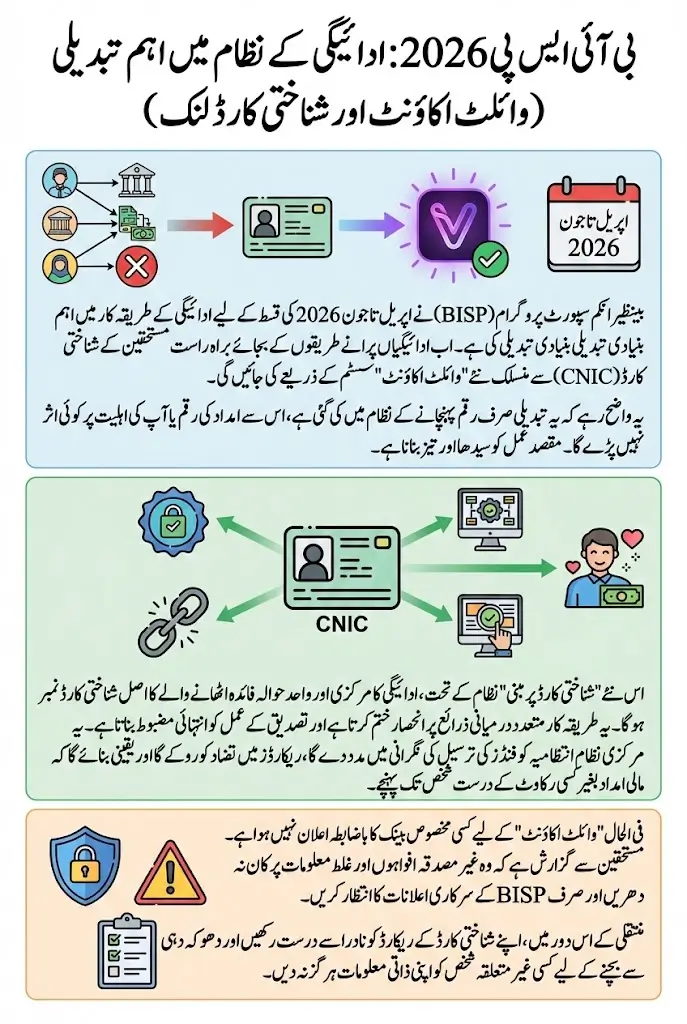
In many districts, people often ask whether this change will affect eligibility or payment amount. Based on the available details, the adjustment focuses on the method of delivery rather than the support itself. The intention appears to be improving verification and reducing confusion that sometimes arises when multiple payment routes operate simultaneously. For ordinary citizens, the most important point is that the payment remains part of the existing support structure, while the system used to deliver it is being updated.
You Can Also Read: Apna Khet Apna Rozgar Scheme Online Registration
How the CNIC-Linked Violet Account Works in Practice
The Violet Account system is described as a mechanism that assigns payments directly against a beneficiary’s CNIC record. Instead of routing funds through separate or intermediary arrangements, the identity number becomes the central reference for payment processing. This structure is expected to strengthen verification and make it easier to track whether funds have been issued and received.
In real terms, this means the beneficiary’s identity is treated as the primary payment channel. Such a method can reduce manual handling steps and may help prevent mismatched records. From a field perspective, identity-based systems typically aim to ensure that financial support reaches the correct person without unnecessary procedural barriers. For families who depend on timely payments, consistency in delivery can significantly reduce stress during the distribution period.
Key features of the new mechanism include:
- Payment assignment directly through CNIC identity
- Reduced dependence on multiple distribution channels
- Stronger verification at the time of payment release
- Centralized monitoring of disbursement records
- Simplified tracking for administrative authorities
You Can Also Read: Ramadan Relief Expansion 2026 New Federal Cash
What Beneficiaries May Experience During the April–June 2026 Cycle
The April to June 2026 installment is expected to be among the first payment cycles to follow the updated distribution method. During such transitions, administrative adjustments usually occur in phases. Beneficiaries may notice differences in notification procedures, verification steps, or collection instructions compared to previous cycles. These adjustments do not necessarily indicate a change in support policy; they often reflect operational improvements designed to streamline the process.
Observations from earlier system changes suggest that temporary uncertainty is common during implementation periods. Beneficiaries may hear different claims regarding banks or payment channels, but final procedures are always confirmed through official communication. Until that confirmation is issued, the payment system should be viewed as being in a transition phase rather than a fully finalized structure.
You Can Also Read: KP Government Announces Increase in Ramadan Relief
Below is a simple overview of the announced payment structure for clarity.
| Installment Period | Distribution Method | Identity Requirement | Bank Confirmation Status |
|---|---|---|---|
| April – June 2026 | Violet Account System | Direct CNIC Linkage | Awaiting Official Announcement |
Banking Partner Status and Official Confirmation Process
At present, no specific bank has been formally announced for handling the Violet Account payments. This point is crucial because unofficial claims often circulate quickly when payment updates are expected. Without formal notification, no financial institution can be considered confirmed or rejected. In administrative practice, payment channels are always validated through official government communication before implementation at scale.
This waiting period can create uncertainty, especially for beneficiaries who depend on clear instructions to plan travel or manage expenses. However, it is important to understand that system transitions require coordination between administrative departments and financial institutions. Until that coordination is finalized, public confirmation remains pending. Acting on incomplete information can lead to unnecessary difficulty for beneficiaries.
Important points to remember regarding bank confirmation:
- No partner bank has been officially declared
- No institution has been ruled out formally
- Final details will be shared through verified channels
- Beneficiaries should avoid relying on informal claims
- Official announcements remain the only reliable source
You Can Also Read: 8070 Registration Online 2026 How to Apply and Check Eligibility
Protecting Beneficiaries from Misinformation and Fraud Risks
Whenever payment methods change, misinformation spreads quickly, particularly through informal networks and unverified messages. During previous distribution periods, many beneficiaries reported confusion due to conflicting instructions. Such situations highlight the importance of caution and verification. Identity-based payment systems are designed to improve security, but beneficiaries must also protect their personal information during the transition.
Maintaining awareness is especially important in rural and semi-urban areas where unofficial intermediaries sometimes claim to provide assistance. Experience from earlier cycles shows that most complications arise when beneficiaries respond to unverified instructions rather than waiting for confirmed guidance. Patience during the transition period can prevent avoidable problems.
Practical safety measures for beneficiaries:
- Share CNIC information only through official procedures
- Avoid paying any person claiming early access to payments
- Verify announcements through recognized channels
- Keep personal contact details updated
- Wait for clear instructions before taking action
You Can Also Read: PSER Online Registration 2026 To Avail Ramzan Package
Administrative Objectives Behind Identity-Based Payment Distribution
Linking payments directly to CNIC records reflects a broader administrative effort to strengthen transparency and accountability in social support delivery. Identity-based distribution reduces dependency on multiple verification layers and supports centralized monitoring. When payments are linked directly to verified identity records, tracking fund flow becomes more efficient and easier to audit.
From an operational perspective, centralized payment structures can help reduce duplication and ensure that support reaches intended recipients. This approach also aligns with digital governance practices that prioritize accuracy in beneficiary identification. Over time, such systems are expected to create more predictable and reliable payment cycles.
Expected administrative outcomes of the new approach:
- Stronger identity verification standards
- Reduced procedural delays in payment issuance
- Improved accuracy in beneficiary records
- Enhanced monitoring of fund distribution
- Greater transparency in public welfare delivery
You Can Also Read: Punjab Laptop Scheme Phase 2 Registration Deadline
Public Expectations and Practical Preparation Steps
Among beneficiaries, there is cautious hope that the CNIC-linked payment model will bring greater clarity to the distribution process. Many families depend on predictable payment timelines to manage household budgeting, particularly during periods of rising living costs. If implemented smoothly, the new structure may reduce uncertainty and improve confidence in the payment system.
Until official operational details are released, beneficiaries are encouraged to focus on preparation rather than speculation. Ensuring documentation is accurate and staying informed through verified updates will help avoid complications when the system becomes fully operational. Experience shows that readiness at the household level often makes the transition smoother once final instructions are issued.
Recommended preparation steps include:
- Ensure CNIC validity and accuracy of personal records
- Stay informed through official announcements only
- Avoid responding to unverified payment messages
- Keep household documentation organized
- Wait patiently for confirmed operational guidance